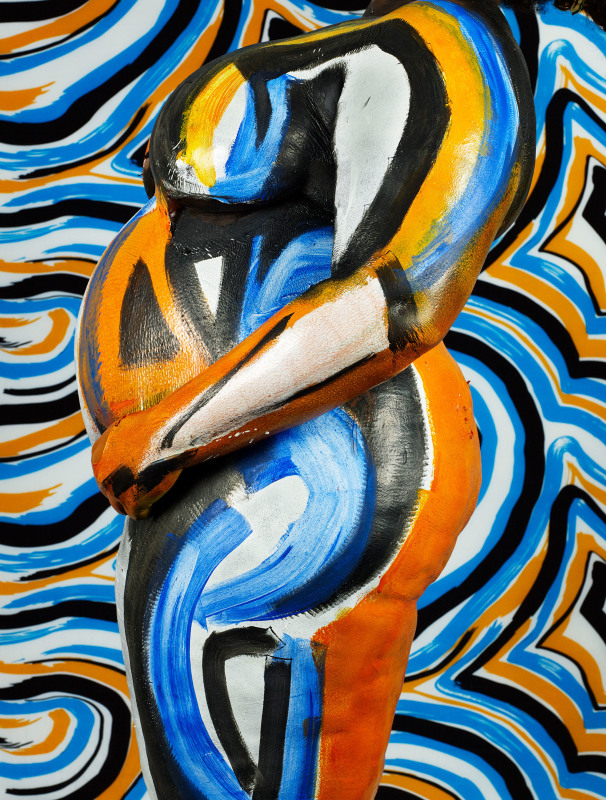
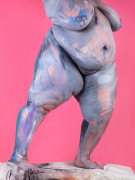
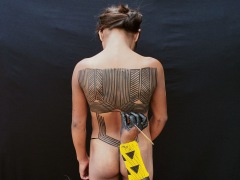
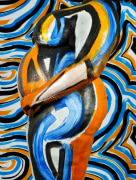
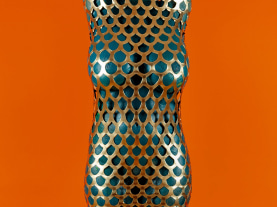
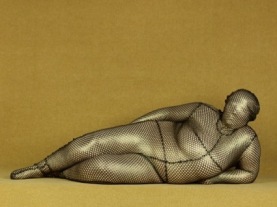
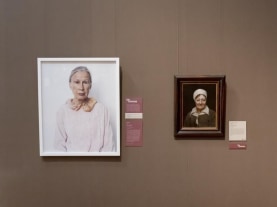
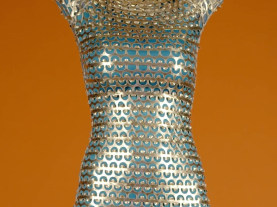
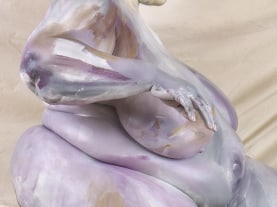
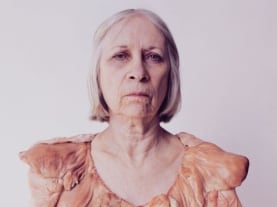
Pinar Yolacan creates bewitching photographic portraits of the female figure that dissolve traditional boundaries between photography, sculpture and painting and grapple with issues of beauty, femininity, fashion, cultural heritage and art history. For her 2012-2014 Nudes series, created during a residency in Sao Paolo, Yolacan photographed mountainous, twisting naked bodies, painted over in a gestural fashion and presented against monochromatic backgrounds, recalling the intimate explorations of flesh and corporality of Jenny Saville, Lucian Freud and Francis Bacon. Nudes evolved into the series Corpo Mecânico in which expressively painted bodies melt into a background of patterned textiles, inspired by Futurist depictions of movement and Duchamp’s Nude Descending the Staircase. She has used fabric to create sculptural female forms, referencing ancient fertility goddesses, and clothed her female sitters in animal placentas and raw chicken flesh. These startling compositions, born of Yolacan’s study of cultures from Turkey to Bolivia, challenge and transform our understanding of the body, registering the passage of time in a celebration of feminine diversity.
Born in Ankara, Turkey in 1981, Yolacan studied Fashion at Central Saint Martins College of Art and Design, and Fine Art Media at Chelsea School of Art before graduating from The Cooper Union with a BFA in 2004. Yolacan has exhibited around the globe, including at CCA, The Center for Contemporary Art, Lagos, Nigeria; Yapi Kredi Foundation, Istanbul, Turkey; Photography NRW-Forum, Dusseldorf, Germany; Finnish Museum of Photography, Helsinki; the J.Paul Getty Museum, Los Angeles, USA; Bass Museum of Art, Miami; MOMA PS1, New York and The Saatchi Gallery, London. She is represented in The Saatchi Collection, London, The Zabludowicz Collection, London, The J. Paul Getty Museum, Los Angeles, Kiasma, Helsinki and the International Center of Photography, New York. She lives and works in New York City.